
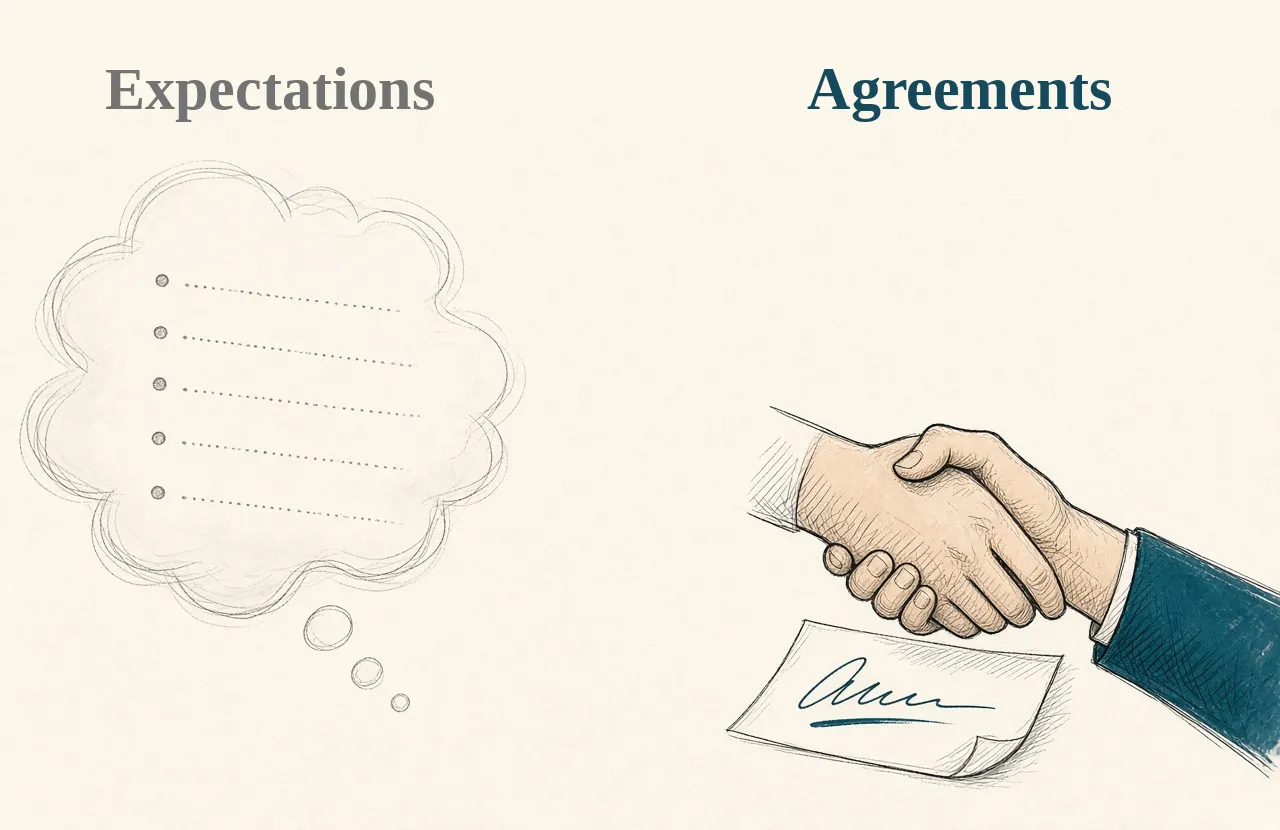
If you’re disappointed in someone, you probably don’t have a people problem. You have an expectation you never turned into an agreement.
I was talking with a founder recently who was frustrated with his team. People were showing up late. An important sale had been announced without giving the staff time to prepare. Some of his team weren’t dressing the part for a [premium, in-person] business.
He was ready to add consequences: written warnings, suspensions, maybe a PIP. He asked me, “How do companies normally discipline people for this stuff?”
I asked him a different question: “What exactly did they agree to?”
Long pause. “Well… I thought they understood.”
That isn’t an agreement. That’s an expectation.
Inside your head vs. between two people
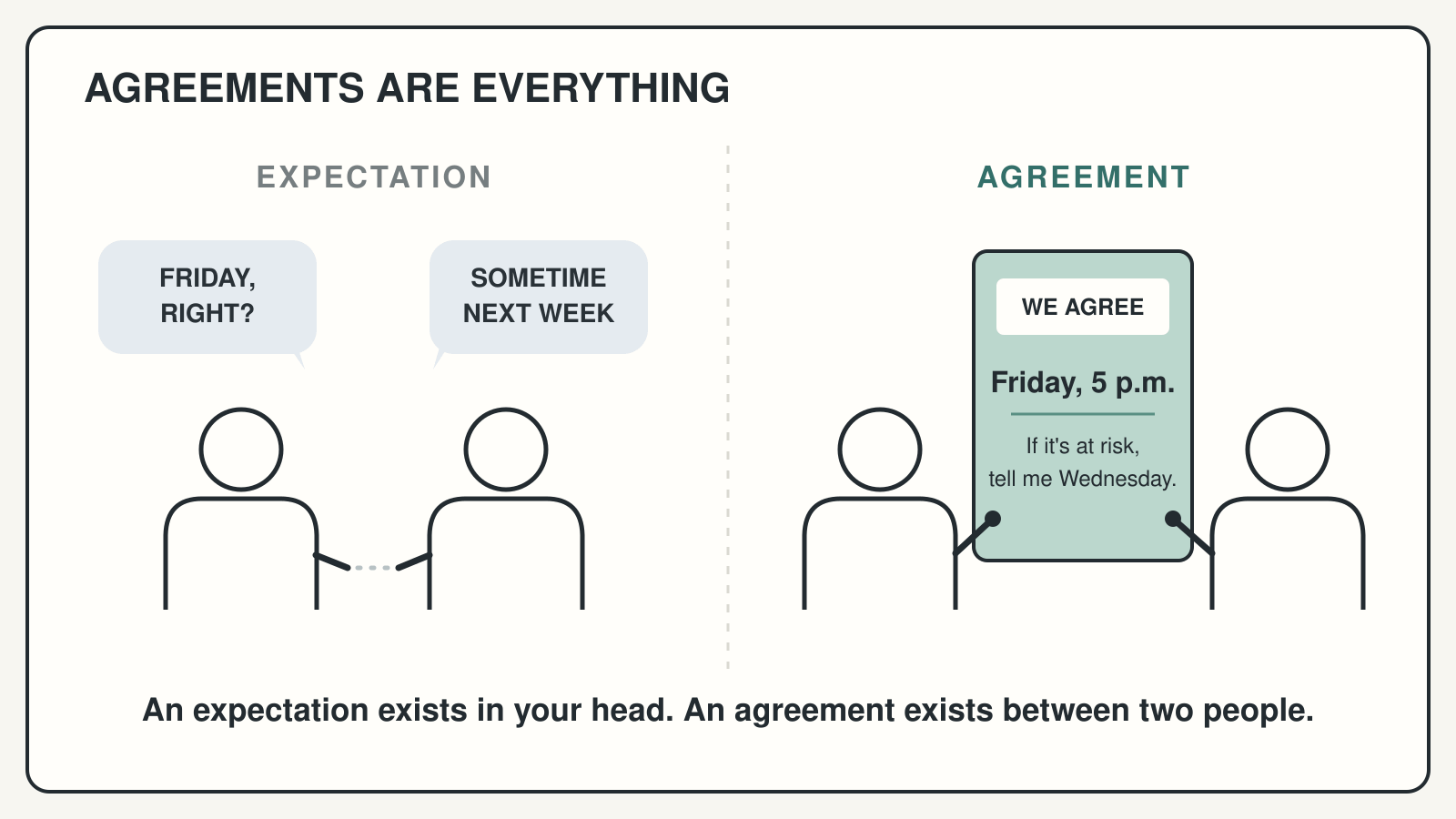
An expectation lives inside your head. An agreement lives between two people. The first one creates resentment and the other moves the company forward.
I’ve written before about how to make a clear agreement ([You’re Not Telepathic]). This post is about what happens after the yes.
Stop yelling at the crops
Every founder has a field full of expectations. Then someone misses and the founder gets pissed. “How could they not know?”
I call this yelling at the crops. You’re furious the corn isn’t growing the way you pictured it. But the corn never saw the picture and is just, well, being corn.
Here’s the uncomfortable part. We don’t need people to be different. We need them to keep their agreements. If they’re keeping their agreements and we still aren’t satisfied, then our agreements are wrong.
Fix the agreement, not the person.
And if you DO want someone to change, make that the agreement and work on it together. You cannot want it more than they do.
Before you call it a performance problem
An agreement is a two-way handshake. When someone makes a commitment to you, it’s your commitment too. So when one breaks, start with your side of the handshake.
There are four ways an agreement breaks:
- Never made. It was an expectation. You told, they nodded, nobody agreed.
- Signed up for failure. It was unrealistic from the start, and you accepted it anyway. Only accept commitments you believe will be kept.
- Left hanging. It was doable, but they needed a check-in or clearer priorities. You weren’t there.
- Silent. They saw it slipping and said nothing until the deadline.
Rule out all four. Only then: they understood it, could do it, had support, knew they were behind, didn’t say anything, and still missed. If that happened, NOW you may have a performance problem.
The agreement inside the agreement
The fourth break is the easiest to fix. Every important agreement should contain another agreement: The moment you think you might not keep this, you tell me.
This doesn’t make deadlines optional. It means no surprises.
If someone tells you on Wednesday that Friday is at risk, you can help, cut scope, move resources, or make a new agreement. If they tell you Friday afternoon, you have very few options other than being pissed off.
When an agreement needs to change, don’t hero. Get a NEW agreement, and this time build in the support so it actually gets kept.
Slow to judge. Fast to let go.
In the show Reacher, they say details matter. Well in a startup, consequences matter. They just come last. Here’s the order:
- Tight agreements.
- Slow to judge.
- A structured middle when problems show up: re-agree, support, check in.
- Fast to let go when someone keeps breaking clear agreements.
I sometimes work with CEOs who are chronically late. Five or ten minutes to almost everything.
So I propose an experiment: if you’re even one minute late to our next session, we cancel and wait until next week. Guess what? They always show up on time.
They were capable of punctuality all along. The agreement just never had a real consequence.
Airlines figured this out a long time ago. They tell you when the door closes, and then they leave without you. That’s why people who are late to everything somehow make their flights.
A consequence doesn’t have to be punitive. It does have to be real. If agreements break and nothing happens, you’re teaching everyone that agreements are optional.
But consequences only work after clarity. Punishing someone for an expectation you never turned into an agreement is not leadership. It’s blaming someone for failing a test they didn’t know they were taking.
This is why firing an employee should never be a surprise. If it is, you skipped the middle.
It’s not just your team
Sloppy agreements show up everywhere:
- Your co-founder. “You handle product, I handle the business” isn’t an agreement. Who decides when you disagree?
- Your board. Do you know exactly what they think your job is over the next [12] months? If not, you’re being graded on a test you haven’t seen.
- Your new hire. What does an excellent first [6] months look like, in writing, agreed by both of you?
- Home and yourself. Your spouse, your kids, your own goals. Who is responsible for emptying the dishwasher?
The tighter your agreements, everywhere, the faster (and happier) you go.
What to do this week
At the end of every 1:1 this week, ask one question: “What did we just agree to?”
Have the other person write it back to you in Slack or email. If their version doesn’t match yours, you just found an expectation. And you found it on Monday instead of Friday.
Your job isn’t to walk around carrying a backpack full of expectations, waiting to be disappointed.
Your job is make sure there are agreements everywhere. Then help people keep them.
Good luck.